


Understanding Hip Mobility: It's more than just stretching
It’s hard to get through daily life without using your hips. Positioned at the center of the body, the hips play a major role in nearly everything we do—standing, walking, transitioning between positions, and even sitting. They need both mobility and stability to function well. When either is limited, everyday movements can quickly become uncomfortable or difficult.
Unfortunately, hip pain and movement restrictions are very common. Today, we’re going to focus specifically on hip mobility and break it down into four key areas that most often contribute to limitations:
Soft tissue restriction
Joint restriction
Poor strength
Poor core stability
This list isn’t all-encompassing, but outside of a specific traumatic event (such as a fracture), most hip mobility issues fall into one—or more often, several—of these categories.
1. Soft Tissue Restriction
Soft tissue restriction refers to tightness in muscles, tendons, ligaments, or fascia. For the sake of this blog, we’ll focus primarily on muscles, though there is significant overlap between all of these tissues.
The hip is controlled by roughly 15–20 different muscles, second only to the shoulder. This is because both are ball-and-socket joints, designed to move in many directions. To manage that movement, a lot of muscles must work together for both motion and stability. Over time, some muscles may become overworked and tight, while others become underactive or “lazy.”
Common muscles around the hip that tend to tighten include:
Hamstrings
Hip flexors (psoas, TFL, rectus femoris)
Hip rotators (piriformis, gluteals, obturator internus/externus, superior and inferior gemelli)
Adductors
We could easily write an entire book on stretching and releasing these muscles, but below are a few of my go-to techniques to start improving flexibility in this area.
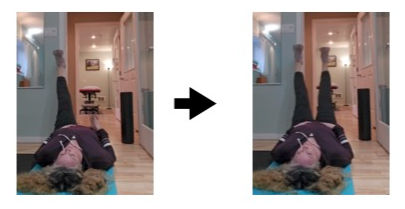
Active Hamstring Stretch: Lay on your back in a doorway. The leg you are stretching is on the wall of the door panel, leg is straight. The opposite leg is going to raise and lower about 10 times (make sure to engage core 1st). Then relax into the stretch. If possible, scoot closer to the door panel, then repeat again. 2-3 sets. For a detailed video: https://youtube.com/shorts/U56LYfwUjEs

2. Joint Restriction
Joint restriction refers to limitations within the hip joint itself. This may be related to degeneration such as osteoarthritis, a labral tear, or—more commonly—tightness in the joint capsule.
Regardless of the cause, creating more space within the joint often leads to improved comfort and better movement. When mobilizing the hip joint, we focus on small, controlled movements at end range. These techniques are often most effective when done passively, which is why hands-on treatment can be especially helpful.
That said, you can still work on joint mobility on your own using a high-resistance band. The goal is to apply tension, move into your available range, and perform very small, controlled movements.
Because the hip moves in multiple planes, there’s no single “magic” mobilization. Instead, we break them into directions that you can safely and effectively perform yourself:
Lateral mobilization: improves overall mobility, hip flexion, and rotation. This can be done on hands and knees with some gentile rocking forward and back, or on your back, with opposite foot crossed over the knee. The opposite foot does the work, pulling the leg you are stretching towards midline, then let the band pull it back. Try and keep the leg you are stretching as relaxed as possible

Anterior mobilization: helps with hip extension (bringing the leg backward). Attach the band in front of you and around the back of your hip (just under your rear end). Use a chair or something to hold on to, and scoot back as far as you can still balance. Place the opposite foot up in a tall kneeling position. Then gently push the rear end back, and then let the band pull you forward. These are very small motions.

Long-axis traction: useful for general hip mobility; can also affect the low back, so proceed with caution if you have back issues. Attach the band around the ankle by criss crossing it over the ankle. Lay on your back, and slowly scoot away from the band anchor, until you get a gentle pull.

*For a full video of mobilizations, go to this link: https://youtu.be/sIVYwRrWkEM
3. Poor Strength
When a muscle is weak, your body often responds by tightening the surrounding tissues to protect the area. This is why some people stretch consistently but see little improvement—strength may be the missing piece.
If stretching alone hasn’t helped your hip mobility, strengthening may be exactly what you need. There are countless strengthening exercises for the hips, but here are two that effectively combine strength and mobility:
Seated hip openers: The goal is to be able to sit with legs straight out in front of you without rounding your back. If you do not have the hamstring flexibility for this, check out my video on modifications prior to starting this: https://youtube.com/shorts/pjkjSC0alF4
If you can sit with the legs out, then engage your core, keep your back and leg straight, and raise it up and out to the side, then return to starting position and repeat on the other side. Try and create as large of an arch as you can without rounding your back. Hint: quad cramping is not uncommon (as you can see in the change of my fascial expression)

Bridge with knee drive: I love this for hip flexor strengthening, but also glute strengthening on the opposite side, and core stability (which leads into our next area). Make sure you can comfortably perform a single leg bridge prior to this. If not, check out this video for progressions: https://youtu.be/dXzU56R_kzc
If you can perform one, then you will attach a band around both feet. Flex the ankles to keep the band attached, then raise your hips up into a bridge. Maintain that position, and drive one knee up as far as you can without loosing the height of the bridge, or rotating. Repeat 5-10x on that side, then take a break, and repeat. For the full video, see here: https://youtu.be/JZim_E_NXbE
4. Poor Core Stability
Core stability goes hand in hand with hip strength. I often ask people to imagine standing on one leg on solid ground—easy for some, challenging for others. Now imagine trying to do that on a boat in rough water. Much harder, right?
Your core muscles (those that stabilize the spine and pelvis) provide the stable foundation your hips need to move efficiently. Without that foundation, the hips have to work overtime, often leading to muscle tightness and discomfort.
Once again, there are many great core exercises, but these two are excellent for training the hip and core together:
Bird dog: Position yourself on hands and knees - hands directly under the shoulders, knees under the hips. Engage your core, and attempt to extend the opposite arm and leg out. The goal is to take them as high as you can without your back arching, or your hips dropping. If you are unsure, balance a stick or cup in the small of your back and make sure it does not move. Repeat on the other side. For a video, follow this link: https://youtu.be/9TPWJnzVVsE

Bridge leg extension: Lay on your back, knees bent. Press your hips up into a bridge. If this feels ok, attempt to extend 1 leg out, not letting your hips drop or rotate. If you are unsure, use a stick over your hips for feedback. Repeat on the other side. For a video, follow this link: https://youtu.be/ZyGxtOLBjbs

This just touches the tip of the iceberg when it comes to mobility of the hips. The important take-away, is it's not only the joint and soft-tissue restrictions limiting your mobility. It often has to do with strength, and even stability of your core. If you are interested in diving into this in more depth, or trying some of these exercises yourself, sign up for my FREE Hip Mobility Workshop on Friday, Jan 23 from 12-1pm at 311 Price St. To sign up and more info, visit my website: www.medicinebymovementwellness.com
Here's to healthy hips!
~Alicia Haseltine PT, DPT, CMPT
*Please know these are suggestions and this is not meant as medical advice, nor does it take the place of a skilled evaluation with a health care provider.


Comments